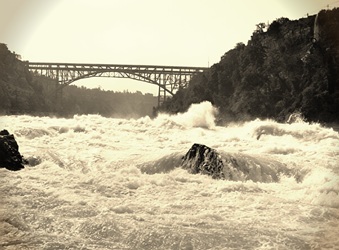
About 2 kilometres (1.2 miles) downstream from Niagara Falls and just below the Rainbow Bridge, you’ll see one of the most unusual crossings along the Niagara River, the Whirlpool Rapids Bridge.
This site has been connecting Niagara Falls, Ontario and Niagara Falls, New York for well over 150 years.
Before the current bridge, this location was home to one of the most ambitious early crossings over the Niagara Gorge.
The idea for a bridge here began in 1848 under the direction of William Hamilton Merritt, with engineer Charles Ellet Jr. leading the original design.
But before construction could begin, they faced a major challenge... getting a cable across the gorge.
With the river far below and too dangerous to cross, a creative solution was used.
A kite-flying contest was held to carry the first line across the 800-foot (244 m) gorge. A young boy named Homan Walsh successfully flew his kite across to the American side.
From that single string, workers pulled across a cord, then a rope, and finally a steel cable...making the first bridge possible.
After early setbacks, engineer John A. Roebling, later known for designing the Brooklyn Bridge, took over the project.
Completed in 1855, his design became the world’s first railway suspension bridge, allowing trains and pedestrians to cross between Canada and the United States.
Some of the original foundation remains visible today.
onstruction of the current Whirlpool Rapids Bridge began on April 9, 1896. The method used was unlike most bridge projects.
Instead of removing the old bridge first, engineers built the new one directly underneath it.
Two halves were extended outward from each side of the gorge and anchored securely into the rock. For a short time, two full bridges existed in the same location, one above the other.
Once the new bridge was complete, the old structure was dismantled and removed.
Train traffic continued throughout construction, while road traffic was only paused for about two hours each day.
The bridge officially opened on August 27, 1897.
here are two key features that make this bridge stand out:
Two-Level Design
Built Beneath an Existing Bridge
Very few bridges in the world were constructed underneath another active bridge — making this a rare engineering achievement.
At first glance, it may look like just another crossing.
But this location tells one of Niagara’s most fascinating stories, from a kite flying across the gorge, to a groundbreaking railway bridge, to a modern structure built around its predecessor.
It’s a perfect example of the history and innovation you’ll find throughout the Niagara region.
Some of the most fascinating parts of Niagara aren’t the ones everyone talks about.
See the hidden details, surprising stories, and overlooked landmarks on our guided Niagara Falls tour.

Best Niagara Falls tour in Canada for 20 years.


