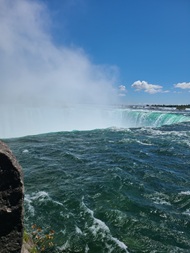
No matter how many photos you’ve seen, it’s different in person.
Niagara Falls was formed at the end of the last Ice Age, when massive glaciers melted and released huge amounts of water into what is now the Niagara River. That water began cutting its way through the land, carving out the gorge you see today.
And it’s still happening.
What you’re looking at here is part of a much larger system.
The Niagara River flows from Lake Erie down to Lake Ontario, and right here, it also forms the natural border between Canada and the United States.
As the river approaches the Falls, it splits around Goat Island. On one side, you have the American Falls and the smaller Bridal Veil Falls. On the other side, you have the much larger Horseshoe Falls, which sits mostly on the Canadian side.
All of that water you’re seeing has been flowing through four of the Great Lakes before it even gets here. Once it reaches this point, it has nowhere else to go but over.
What makes the Falls possible in the first place comes down to the layers of rock beneath the river.
At the top, there’s a hard layer of limestone. Underneath it is a much softer layer of shale. As the water flows over the edge, it slowly erodes the softer rock underneath, creating a hollow space. Eventually, the harder limestone above loses support and breaks away.
That process has been repeating for thousands of years, which is why the Falls have gradually moved upstream to where they are today.
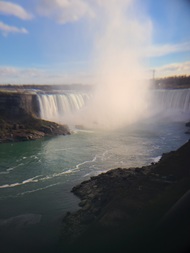
The Horseshoe Falls, the largest of the three, has that curved shape for a reason.
Because of the way the water flows and erodes the rock, the centre tends to wear away faster than the edges. Over time, that creates the rounded “horseshoe” shape you see today.
Across the river, the American Falls and Bridal Veil Falls sit on slightly different rock formations, which is why they look more jagged and broken compared to the smooth curve of the Horseshoe.
Even though it looks permanent, Niagara Falls is constantly changing.
In the past, the Falls were eroding much faster, in some periods, as much as about a metre (3 feet) per year. Today, that rate has slowed significantly to just a few centimetres ( about an inch) per year.
The reason is human intervention. A large portion of the Niagara River’s water is now diverted for hydroelectric power generation, especially at night and during the off-season. With less water flowing over the Falls at certain times, the erosion process has slowed down.
So while the Falls are still moving, they’re doing it much more gradually than they once did.
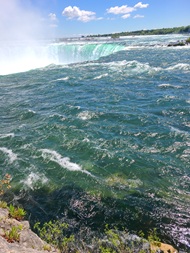
One thing people always notice is the colour of the water.
That deep blue-green look comes from minerals and extremely fine rock particles suspended in the water. When sunlight hits it, those particles scatter the light in a way that gives the river that bright, almost glowing colour, especially just before it goes over the edge.
It might look calm at the top, but underneath, it’s moving incredibly fast.
There are a few things about Niagara Falls that tend to catch people off guard.
At peak flow, more than 2,800 cubic metres of water per second rush over the Falls. That’s enough to fill an Olympic-sized swimming pool in about a second.
The mist created by the Falls rises high into the air and can often be seen from miles away. On sunny days, that same mist is what creates the frequent rainbows you’ll see near the Horseshoe Falls.
In 1969, the American Falls was actually temporarily “turned off.” The U.S. Army Corps of Engineers diverted the water to study erosion and rock stability, leaving the falls dry for several months.
Niagara Falls has also never completely frozen over, but in 1848, strong winds stopped the flow of water from Lake Erie long enough that the river nearly ran dry, leaving the Falls reduced to just a trickle.
And if you’re wondering about the sound... that constant roar you hear can reach up to 90 decibels, about as loud as a motorcycle, depending on where you’re standing.
All of this is interesting on its own, but it really comes together when you’re standing there.
You can see the layers, the movement, the colour, and the scale all at once. It gives you a much better sense of just how powerful the river is, and how long it’s been shaping the landscape.
If you’re ready to experience it in person, you can book your Niagara Falls day tour here.

Best Niagara Falls tour in Canada for 20 years.


