As we travel through the Niagara region, we pass one of the most powerful hydroelectric facilities in North America: the Robert Moses Niagara Power Plant.
Its story begins with disaster.
In June of 1956, a structural failure caused the collapse of much of the nearby Schoellkopf Power Station, cutting off a major source of electricity on the American side of the Niagara River.
With demand for power continuing to grow, the United States needed a safer, larger, and more modern facility — one that could fully harness the energy of Niagara Falls.
Construction of the new plant began on March 18, 1957, in Lewiston, New York, just downstream from the falls.
Named after Robert Moses, a major figure in New York’s infrastructure development, the station officially opened on January 28, 1961.
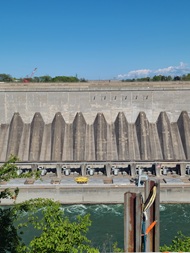
When it opened, the Robert Moses plant was the largest hydroelectric power station in the Western world.
Operated by the New York Power Authority, it was designed to safely generate massive amounts of electricity while working with, rather than against, the natural flow of the Niagara River.
The scale of this operation is enormous.
Water is drawn from the Niagara River about 2.5 miles upstream from the falls along the American shoreline. Every second, approximately 600,000 gallons of water are diverted through two intake structures located below the surface of the river.
From there, the water travels through massive underground tunnels (each about 700 feet (213 m) long) before entering twin conduits that stretch roughly 4 miles (6 km) inland.
These conduits, large enough to fit a multi-storey building inside, carry the water to a forebay, a holding area where the flow is carefully controlled before entering the turbines.
From the forebay, water is directed through enormous pipes called penstocks, each about 460 feet (140 m) long and over 28 feet (8.5 m) in diameter.
This water drives 13 turbines, each producing approximately 200,000 horsepower.
After spinning the turbines, the water is released back into the Niagara River downstream.
In total, the plant has a generating capacity of about 2,300 megawatts, enough to supply electricity to millions of homes and businesses.
To help manage energy demand, the system also includes a massive reservoir covering about 1,900 acres.
This reservoir can store up to 22 billion gallons of water, allowing the plant to hold water back during low-demand periods and release it during peak daytime hours when electricity use is highest.
Niagara Falls is often seen as a natural wonder, but it is also one of the most important sources of hydroelectric power in North America.
The Robert Moses Power Plant shows how that natural force is carefully controlled and used to generate electricity on a massive scale.
It’s a powerful example of how engineering and nature come together in the Niagara region.
There’s more to Niagara than what meets the eye.
Join us on our guided Niagara Falls tour from Toronto and discover the landscapes, engineering, and hidden stories that make this region so remarkable.

Best Niagara Falls tour in Canada for 20 years.


