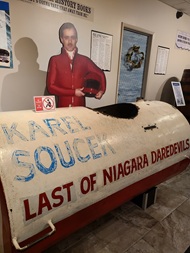
In 1984, Karel Soucek, a 30-year-old from Hamilton, Ontario, set out to make his mark on Niagara Falls.
He didn’t just build a barrel.
He built a statement.
Painted bright red, with the words “Last of Niagara’s Daredevils” and his name across it, Soucek’s barrel was a 9-foot-long, 5-foot-wide cylinder, reinforced and insulated with liquid foam — designed to withstand the power of Horseshoe Falls.
But getting over the Falls wasn’t as simple as showing up and jumping in.
At one point, Soucek’s plans were interrupted by hydro authorities, who were monitoring water flow and safety conditions along the river. Like many before him, even getting to the brink required timing, persistence… and a bit of luck.
Soucek would make more than one attempt before everything finally came together.
When it did, the ride over the Falls lasted only seconds.
What followed was much longer.
His barrel became trapped in the violent, swirling waters below, spinning in the current for 45 minutes before his ground crew was finally able to reach him in the Niagara River.
Against the odds, he survived.
Bruised and cut, but alive, Soucek was taken to a local hospital in Niagara Falls, Ontario. He was later fined $500 under the Niagara Parks Act, a penalty he willingly paid.
But for Soucek, this wasn’t the end.
He planned to turn his survival into a career, touring and recreating his stunt for live audiences.
Just seven months later, on January 19, 1985, he stepped into a barrel again, this time at the Houston Astrodome in Texas.
The plan was to drop 180 feet into a 10-foot-deep tank of water.
But something went wrong.
As the barrel fell, it began to spin… and instead of landing cleanly, it struck the edge of the tank.
Soucek suffered severe injuries.
He did not survive.
Today, Karel Soucek is buried at Drummond Hill Cemetery, not far from the very river he once challenged, a reminder of one of Niagara’s last great daredevil stories.
Stories like Karel Soucek remind you that even in modern times, people were still drawn to test themselves against that power.
By the 1980s, the risks were well known. Laws were in place. And yet, Soucek still chose to go over the Falls, not once, but after multiple attempts to make it happen.
Hearing this story while looking at the river below adds a different perspective. The height, the current, and the force of the water become more than just scenery.
It becomes a place where people continued to take risks, even when they knew exactly what could happen.
There’s a difference between seeing Niagara Falls… and understanding it.
Stand at the edge of Horseshoe Falls, hear the roar, and experience the place where these stories actually happened.
Join us on a guided day tour and discover the details, history, and moments that turn a visit into something unforgettable.

Best Niagara Falls tour in Canada for 20 years.


