Today, when people think of Niagara Falls, they usually picture the waterfalls.
But in the late 1800s, some of the world's brightest minds saw something else.
They saw power.
And no one played a bigger role in unlocking that power than Nikola Tesla.
Nikola Tesla was a Serbian-American inventor, engineer, and physicist whose ideas helped shape the modern electrical world.
While many inventors of the time were focused on improving existing technology, Tesla was developing entirely new ways to generate and transmit electricity.
One of his most important breakthroughs was the development of Alternating Current, or AC power.
Unlike the Direct Current (DC) systems being promoted by Thomas Edison, AC electricity could travel much longer distances efficiently and economically.
That made it a perfect match for a place like Niagara Falls.
By the late 1800s, engineers knew Niagara Falls had enormous potential as a source of hydroelectric power.
The problem wasn't generating electricity.
The problem was getting that electricity to homes, businesses, and factories miles away.
Over the years, numerous solutions had been proposed. Some suggested Direct Current, others proposed compressed air, while still others promoted different types of AC systems.
No one could agree on the best approach.
In 1893, Richard Dean Adams, head of the Niagara Falls Cataract Construction Company, sought advice from Tesla.
Adams wanted to know which system could reliably transmit power generated by Niagara Falls.
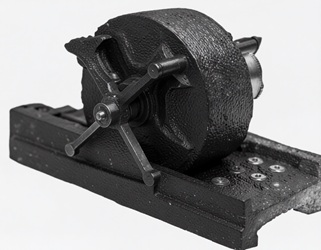
After reviewing the competing technologies, Tesla recommended a two-phase Alternating Current system.
He believed it was the most practical and reliable solution for transmitting electricity over long distances.
That recommendation would change Niagara Falls forever.
Based largely on Tesla's advice and inventions, the contract to build Niagara's generating system was awarded to Westinghouse Electric.
The generators installed at Niagara Falls were based on Tesla's AC technology.
When the system began operating, electricity generated by the Falls was successfully transmitted to nearby cities and eventually to Buffalo, New York.
For the first time, a massive natural source of energy was being delivered over long distances on a commercial scale.
It was a historic achievement.
The success of the Niagara project helped prove that Alternating Current was the future of electricity.
The project became one of the most important victories in the famous "War of Currents" between Tesla's AC system and Edison's DC system.
More importantly, it demonstrated that hydroelectric power could be generated in one location and transmitted to communities far away.
Today, the hydroelectric stations surrounding Niagara Falls still produce electricity for millions of people.
And much of that success can be traced back to Tesla's vision and the technology he helped develop.
In many ways, Niagara Falls became the place where Tesla's ideas proved they could power the world.
Tesla's contributions to hydroelectric power are still remembered in Niagara Falls today.
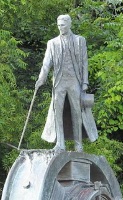
A statue of Nikola Tesla stands in Queen Victoria Park overlooking the Falls. Unveiled in 2006, the monument recognizes the role Tesla's inventions played in harnessing the power of Niagara Falls and helping shape the modern electrical grid.
Many visitors walk past the statue without realizing that the technology Tesla helped develop was instrumental in transforming Niagara Falls into one of the world's most famous hydroelectric sites.
Niagara's story isn't just about waterfalls. It's also about inventors, engineers, and ideas that changed the world.
Join us on a guided tour from Toronto and discover the stories that helped make Niagara Falls one of the most important places in the history of electricity.

Best Niagara Falls tour in Canada for 20 years.


