As you travel through the Niagara region, you'll come across the name Brock again and again.
There's Brock's Monument, Brock University, Brock Street, and countless reminders of a man who became one of the most famous figures in Canadian history.
But who was Sir Isaac Brock?
Born on the island of Guernsey in 1769, Sir Isaac Brock was a British Army officer who arrived in Canada in the early 1800s.
By the time the War of 1812 began, Brock was responsible for helping defend Upper Canada against an American invasion.
The situation wasn't promising.
American forces outnumbered many of the defenders, and there was growing concern that Upper Canada could be lost.
In the summer of 1812, American General William Hull crossed into Upper Canada before retreating to Fort Detroit.
Brock saw an opportunity.
Working alongside Tecumseh and his Indigenous warriors, Brock devised a plan to make his force appear much larger than it actually was.
The strategy worked.
Believing he was facing overwhelming numbers, Hull surrendered Fort Detroit without a major battle.
The victory shocked both sides.
Not only had Brock captured a fort and an entire American army, but he had also transformed the mood in Upper Canada from fear to confidence.
The victory earned him a knighthood and the nickname "The Hero of Upper Canada."
Just two months later, the war arrived in Niagara.
On October 13, 1812, American forces crossed the Niagara River and captured a strategic position on the heights above Queenston.
When Brock learned of the attack, he immediately rode from nearby Fort George to the battlefield.
Rather than waiting for reinforcements, he chose to lead a counterattack himself.
As he advanced toward the American position, Brock was struck by enemy fire and killed.
He was just 43 years old.
Although Brock died that morning, British troops, Canadian militia, and Indigenous allies eventually regained control of the heights and won the battle.
More than 900 American soldiers were taken prisoner.
Brock was first buried at nearby Fort George, but later moved to the top of Queenston Heights.
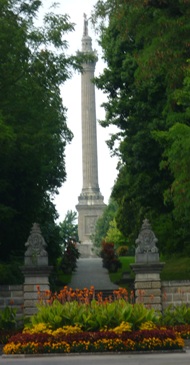
Today, a towering monument stands above the Niagara River in his honour.
At 50 metres (164 feet) tall, Brock's Monument remains one of the most recognizable landmarks in the Niagara region.
Visitors who climb to the top are rewarded with spectacular views of the Niagara River, the surrounding countryside, and one of the most important battlefields in Canadian history.
More than two centuries after his death, Sir Isaac Brock remains one of Niagara's most enduring historical figures.
The Niagara region is filled with places where history happened. From battlefields and monuments to the Niagara River itself, the stories of the War of 1812 are still woven into the landscape today.
Join us on a guided tour from Toronto and discover the people, places, and events that helped shape Niagara's past.

Best Niagara Falls tour in Canada for 20 years.


